


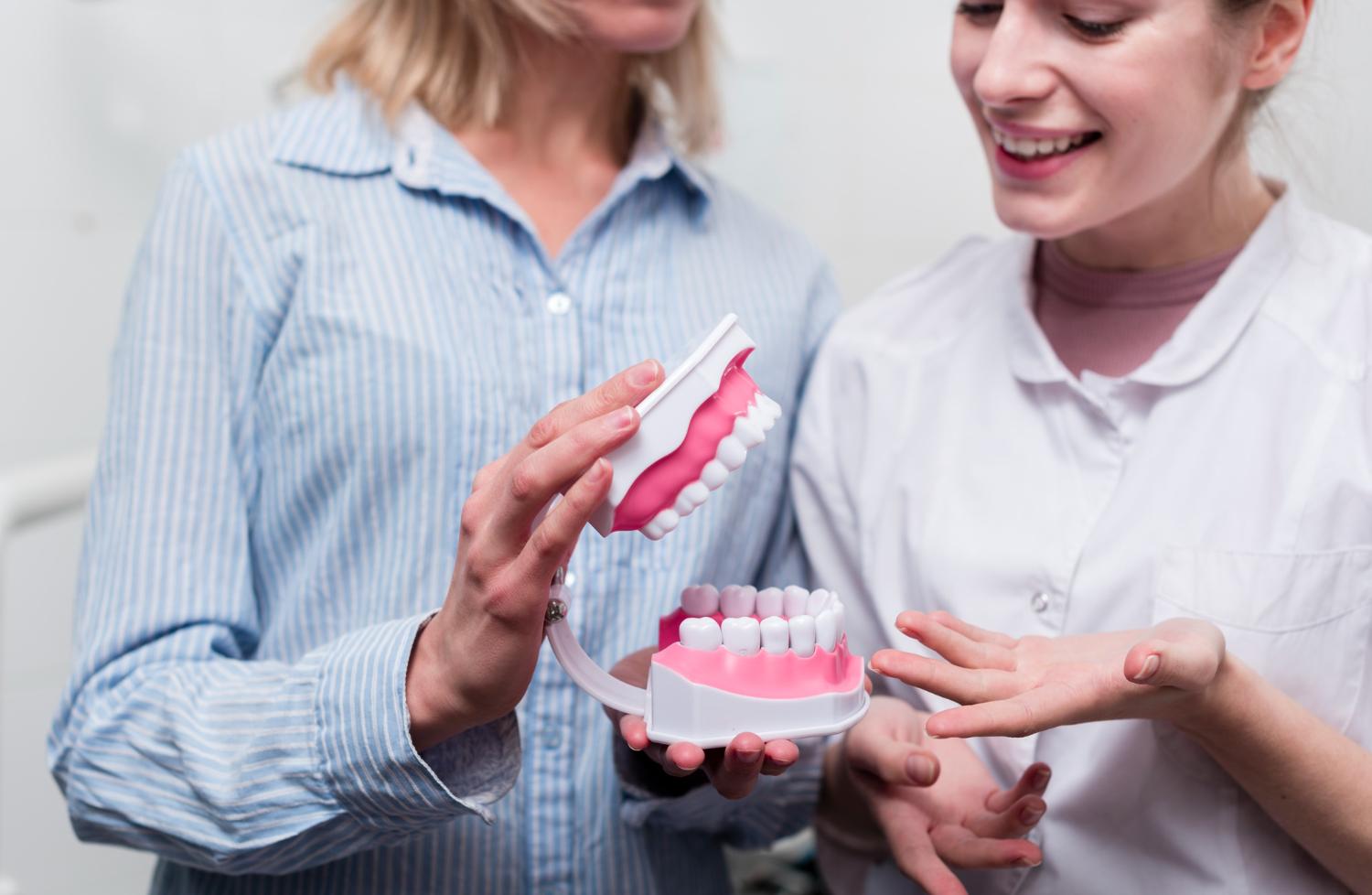
When a patient loses one or more teeth and arrives at the question of how to replace them, they are typically facing a decision that has meaningful long-term consequences for their oral health, their daily function and their quality of life. Dentures and dental implants are both well-established tooth replacement options, but they address the problem in fundamentally different ways, and the one that is right for a specific patient depends on factors that vary considerably between individuals.
What dentists consider before making a recommendation
The Canadian Dental Association (CDA) provides patient education resources on tooth replacement options, noting that the appropriate choice depends on the number of teeth being replaced, the health of the remaining teeth and bone, the patient’s overall health status, budget considerations and the patient’s own priorities regarding convenience, aesthetics and longevity.
A dentist’s recommendation does not begin with product preference but with assessment. How much bone remains in the jaw at the site of the missing tooth? If bone loss has been significant, the surgical prerequisites for a successful implant may require bone grafting before placement becomes feasible. What is the condition of the surrounding teeth? If adjacent teeth are already compromised and will likely need replacement themselves, a partial denture that incorporates those teeth may be more practical than a bridge or individual implants for each one. What is the patient’s medical history? Certain conditions, including uncontrolled diabetes, some autoimmune conditions and the use of certain medications, affect implant healing and osseointegration outcomes.
What each option actually provides
A denture is a removable appliance. Complete dentures replace all teeth in the upper or lower arch, or both. Partial dentures replace some missing teeth and are anchored to remaining natural teeth with clasps or precision attachments. Dentures are made of an acrylic or metal base with porcelain or acrylic teeth, and a well-fitted denture restores chewing function, speech and appearance to a significant degree. They require daily removal for cleaning and can become less stable over time as the jawbone changes shape in the absence of tooth roots.
A dental implant is a small biocompatible titanium screw placed surgically into the jawbone to replace the root portion of a missing tooth. An abutment connects to the implant, and a crown, bridge or implant-retained denture is attached above the gumline. Because the implant integrates with the bone through a process called osseointegration, it provides a stable, permanent anchor that functions much like a natural tooth root.
Helping patients choose at practices like Burnaby Mountain Dental
At Burnaby Mountain Dental in Coquitlam, BC, the conversation about tooth replacement involves a thorough clinical assessment combined with a discussion of what the patient is actually looking for: how much they value the permanence and feel of implants compared to the lower upfront cost of dentures, how they weigh the surgical recovery period against long-term stability, and what their experience has been with the option if they have tried one before.
For patients who have been wearing dentures for some time and find the fit has become problematic due to bone resorption, implant-retained overdentures offer a middle option: a limited number of implants placed to provide attachment points that dramatically improve denture stability, without the cost of replacing every tooth with an individual implant.
The bone preservation argument for implants
One of the most significant clinical arguments in favour of implants, particularly when replacing teeth in younger patients, is bone preservation. When a tooth root is no longer present in the jaw, the bone that surrounded it begins to resorb over time. This is why long-term denture wearers often experience changes in facial appearance and progressively worsening denture fit: the bony ridges that support the denture are diminishing. Dental implants stimulate the bone through the forces of chewing in a manner similar to a natural tooth root, significantly slowing or preventing this resorption.
For patients who lose teeth in their forties or fifties, the cumulative effect of bone resorption over several subsequent decades is a meaningful consideration that a dentist will raise during the treatment planning conversation.
Cost and accessibility
The upfront cost of dental implants is significantly higher than dentures. A single implant including the crown can cost several thousand dollars, while a full set of dentures typically costs less than the equivalent number of implants. For patients replacing a full arch or multiple arches, the cost differential is substantial.
However, the total cost calculation over a lifetime changes when maintenance, replacement and the complications of bone resorption are included. Dentures may need to be relined or replaced as the jaw changes shape. Implants, when properly placed and maintained, can last for decades or a lifetime. The correct comparison is not upfront cost but expected long-term cost of ownership, and patients benefit from having that conversation explicitly with their dentist rather than evaluating the options based on initial price alone.